
ESUN: Ethernet Walks Into the Rack and Says "I Can Do That Too"
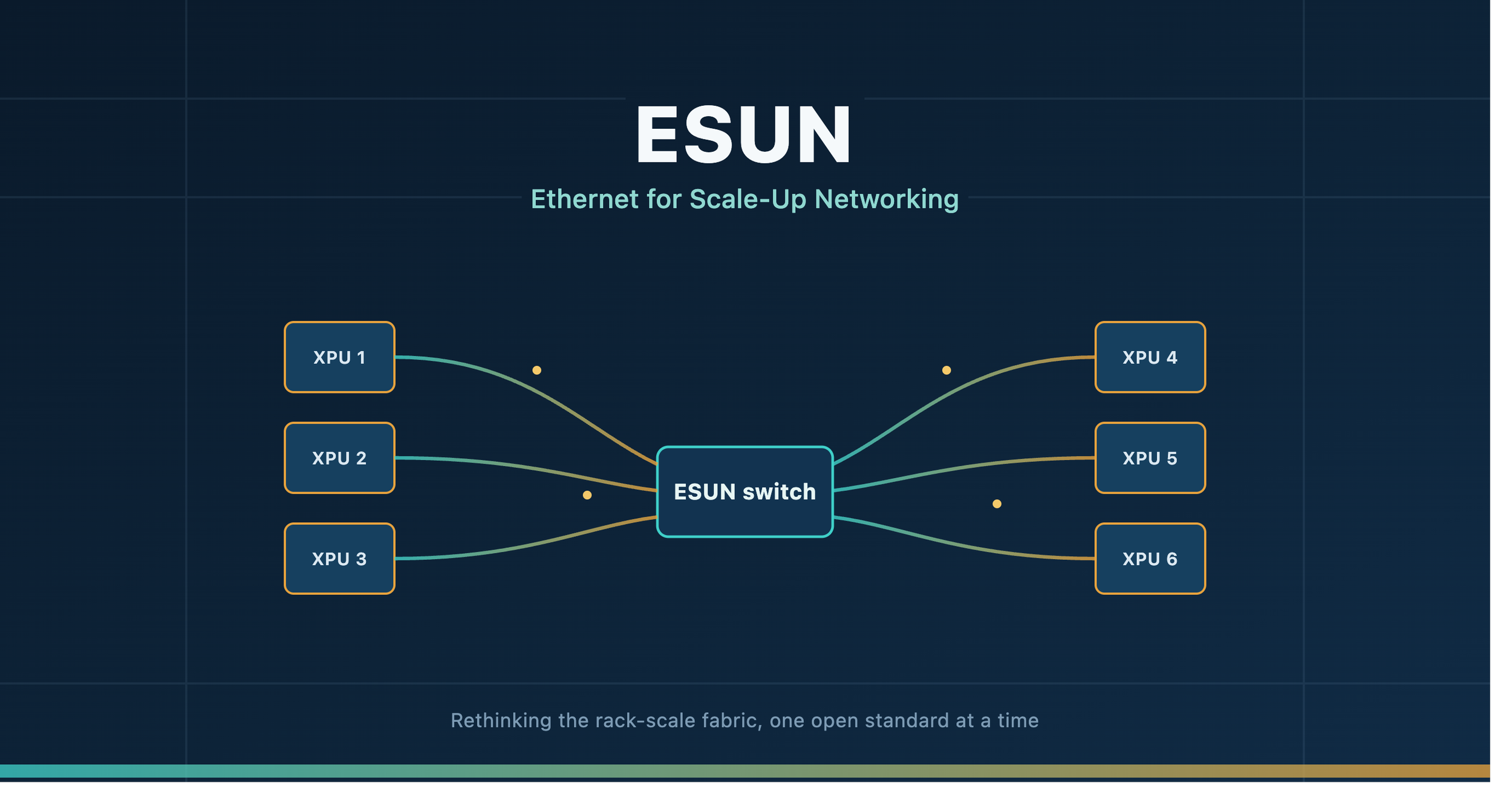
For the longest time, Ethernet's job inside an AI data center was humble and well understood: connect racks to racks, buildings to buildings, the outside world to the inside. The tight, ultra-fast, chip-to-chip conversations happening within a single rack or pod were somebody else's problem — usually NVIDIA's, courtesy of NVLink and NVSwitch. That division of labor is now being challenged. Ethernet, the old workhorse, wants a seat at the scale-up table too. The vehicle for that ambition has a name: ESUN, Ethernet for Scale-Up Networking.
I've written before about CXL and its very own tug of war for relevance, and about SOCAMM's attempt to reshape memory modules for AI. ESUN belongs to the same family of stories: the industry's collective, sometimes messy, attempt to keep open standards in the game even as proprietary fabrics sprint ahead. Let's get into it.
What Exactly Is a Scale-Up Network?
Before ESUN makes sense, scale-up needs to make sense.
Picture an AI data center as having three concentric rings of networking:
Scale-up: the innermost ring, connecting a handful to a couple of thousand XPUs (GPUs, accelerators, whatever silicon is doing the matrix math) within one or a few racks, so tightly that they behave like a single giant compute engine.
Scale-out: the middle ring, connecting many such pods or racks together into a larger training or inference cluster.
Scale-across: the outermost ring, stitching multiple data centers together for workloads too big to fit in one building.
Scale-up is the ring where the physics gets unforgiving. We're talking sub-microsecond latencies, memory-semantic load/store operations, and bandwidth measured in terabytes per second per accelerator, because collective operations like all-reduce and all-to-all (the bread and butter of distributed training) stall the moment any one link lags. A GPU idling because a neighbor hasn't finished a memory write is a GPU that just became very expensive scrap heat.
This is precisely the domain NVIDIA has owned with NVLink and NVSwitch, letting up to a few hundred GPUs behave as one coherent memory pool. It works, and it works well. It is also entirely proprietary.
Why the Industry Wants an Alternative
Here's the uncomfortable truth every hyperscaler and neocloud operator has quietly acknowledged: betting the entire scale-up layer on one vendor's fabric means betting the entire roadmap, pricing, and supply chain on one vendor's fabric. When your AI infrastructure spend is measured in tens of billions of dollars, single-vendor dependency stops being a technical footnote and becomes a boardroom conversation.
The industry's response has come in two flavors - UALink and ESUN
ESUN takes a different, arguably more conservative path; it asks how far standard Ethernet — the physical layer, the framing, the switching that already runs the rest of the data center — can be stretched to do the scale-up job.
Both ideas are explicit reactions to the same discomfort: an open, multi-vendor answer to NVLink is now considered infrastructure-critical, not a nice-to-have.
Enter ESUN
ESUN was unveiled at the OCP Global Summit in October 2025 as a new Open Compute Project (OCP) Networking workstream. Its founding member list reads like a who's who of the data center world: AMD, Arista, Arm, Broadcom, Cisco, HPE Networking, Marvell, Meta, Microsoft, NVIDIA, OpenAI, and Oracle.
Yes, NVIDIA is in that list too!
ESUN's charter, deliberately narrow: define open, standards-based Ethernet switching and framing for scale-up networking. It explicitly stays out of host-side protocol stacks, non-Ethernet protocols, application-layer choices, and anything proprietary. In other words, ESUN doesn't try to be everything; it tries to be the plumbing that everything else can run on top of.
The Technical Architecture
ESUN's building blocks sit in three layers:
Common Ethernet headers for interoperability: this is what lets a wide range of upper-layer transports and use cases ride on the same underlying frame format across vendors.
Open Ethernet data-link layer: the layer that actually keeps scale-up traffic lossless and fast, leaning on established, standards-based mechanisms such as Link-Layer Retry (LLR), Priority-based Flow Control (PFC), and Credit-Based Flow Control (CBFC). At pod scale, even a brief stall here can hold up thousands of concurrent operations, so this layer carries a lot of the performance burden.
Ethernet PHY layer: by riding on the same ubiquitous Ethernet physical layer already used everywhere else, ESUN keeps the door open to multiple vendors and a wide mix of optical and copper interconnects, rather than locking implementers into one physical technology.
ESUN doesn't work in isolation — it deliberately leans on IEEE 802.3 for the physical layer and coordinates closely with the Ultra Ethernet Consortium (UEC), whose original charter focused on scale-out and is now extending into scale-up too.
SUE-T: The Companion Piece
Sitting alongside ESUN is SUE-T (Scale-Up Ethernet Transport), a related but separate OCP workstream. SUE-T traces its roots to Broadcom's contribution of its own SUE (Scale-Up Ethernet) specification to OCP.
Where ESUN focuses on the network side (switch framing, headers, lossless delivery), SUE-T addresses the XPU-endpoint side: reliability scheduling, load balancing, and transaction packing — the kind of functionality that has to be tightly co-designed with the accelerator itself.
The USP
What is ESUN actually selling as its unique proposition? A few things, taken together:
No new physical layer to invent, qualify, or wait for. Ethernet PHYs, optics, and copper are already a mature, multi-vendor, cost-efficient ecosystem.
Multi-vendor interoperability by design, since it builds on headers and mechanisms the industry already agrees on, rather than a fresh proprietary stack.
Flexibility at the top. XPU designers retain freedom of choice on access models (push versus pull), transport reliability (hop-by-hop versus end-to-end), ordering rules, and congestion control, while still relying on a common Ethernet foundation underneath.
A credible growth path from what already exists, rather than a rip-and-replace proposition, which matters enormously to operators who have spent two decades building operational muscle memory around Ethernet.
In effect, ESUN's pitch is: you already trust Ethernet everywhere else in your data center; here's how to trust it inside the rack too.
Where ESUN, UALink, and UEC Actually Stand Relative to Each Other
This is the part that trips people up, so let me be as precise as I can.
UEC (Ultra Ethernet Consortium), formed in 2023 by AMD, Arista, Broadcom, Cisco, HPE, Intel, Meta, and Microsoft, originally targeted scale-out, an open Ethernet-based alternative to InfiniBand for connecting many pods together. UEC published its 1.0 specification in mid-2025 and has since begun extending its work into scale-up as well.
ESUN, an OCP workstream (not a standards body issuing its own protocol spec from scratch), is scale-up specific, and explicitly leans on both IEEE 802.3 and UEC's work rather than duplicating it. Think of ESUN as the forum coordinating how switches and XPU-facing interfaces implement scale-up Ethernet in practice.
UALink is not Ethernet-native in the same sense; it defines its own memory-semantic protocol and transaction layer, purpose-built for load/store operations between accelerators, though its 1.0 specification does use the IEEE 802.3-based PHY for its physical layer, and later work has explored running UALink over Ethernet (referred to in places as UALoE) for longer-reach, multi-rack scenarios.
So rather than being strict rivals, ESUN and UALink increasingly look complementary, particularly at the physical layer. It's plausible, and even likely, that a real deployment ends up using UALink inside a tightly packed pod for memory-semantic accelerator-to-accelerator traffic, while leaning on ESUN and SUE-T-aligned Ethernet behaviors for interoperability, operations, and the handoff to scale-out. Underneath both, the physical-layer story converges on the same high-speed SerDes and optics.
And NVIDIA's NVLink, still the incumbent to beat, continues to hold the performance and ecosystem-maturity crown for now, backed by nearly a decade of CUDA and NCCL optimization that neither ESUN nor UALink can match overnight.
A Dose of Realism
I'd be doing you a disservice if I dressed this up as a done deal.
ESUN is a workstream, not a finished, ratified protocol with shipping silicon. It was only unveiled in October 2025, and specification work of this nature — especially when multiple large companies with competing priorities are at the table — tends to move at a pace that outsiders find frustratingly slow, however necessary that pace is for getting the details right.
UALink, further along on the specification front with successive updates and even a set of additional specifications on in-network compute, chiplets, and manageability, still awaits meaningful shipping silicon at scale; most estimates point to late 2026 at the earliest for real hardware, with production deployments more realistically stretching into 2027.
NVLink, meanwhile, isn't standing still. It ships today, at scale, with a software ecosystem that took the better part of a decade to mature. Open standards have to close a real and current performance-plus-maturity gap, not just a paper one.
And there's the perennial standards-world risk: too many well-intentioned initiatives (ESUN, SUE-T, UEC, UALink) chasing overlapping ground can create as much confusion as clarity for the operators who ultimately have to choose and deploy. The stated intent to keep these efforts complementary rather than competitive is encouraging; whether that discipline holds as commercial pressure mounts is the thing to watch.
Outlook
I read ESUN as a signal more than a spec: the biggest names in AI infrastructure, including NVIDIA itself, agree that scale-up networking cannot remain permanently proprietary if the industry is going to scale to the million-XPU clusters now being discussed openly. Ethernet has reinvented itself for every networking era so far, from campus LANs to hyperscale data centers to (arguably) scale-out AI fabrics through UEC. Whether it can now credibly reinvent itself for the unforgiving, sub-microsecond world of scale-up is the open question that will play out over the next couple of years, likely through 2027 and beyond, as ESUN-aligned silicon, UALink hardware, and NVLink's next generations all compete for the same racks.
What's certain is that the open-standards side of this story finally has real momentum and real vendor commitment behind it, rather than just aspiration.
I might have missed some angles or recent developments on ESUN. Please comment and let me know; I'll fold in anything I've missed.
